
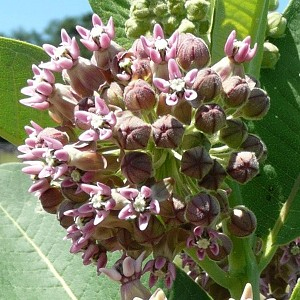
COMMON NAME: Common Milkweed
SCIENTIFIC NAME: Asclepias syriace – named for a Greek god of healing and the mistaken idea that the plant came from Syria. Named by Linnaeus.
FLOWER: Cream to pink clusters 2 to 4 inches across of individual flowers, each with 5 downward point petals. The blossoms are quite fragrant.
BLOOMING PERIOD: June to August
SIZE: Erect perennial, 3 to 6 feet tall, with an unbranched stem.
BEHAVIOR: This is the milkweed that monarch butterflies. The caterpillars feed on the foliage that contains a milky substance that is quite bitter. Insects that feed on milkweeds repel predators by the toxicity that they acquire from this plant.
SITE REQUIREMENTS: Full to partial sun; dry to wet soil; fields, prairies; sandy loamy soil.
NATURAL RANGE: Most of southern Canada, east of the Rockies, south in the U.S. to Georgia and west to Kansas and Iowa. It is found throughout Wisconsin.
SPECIAL FEATURES: When the central stem or leaves are torn, a milky say oozes out. After the flowers fade a seedpod forms that is 3-4 inches long and covered with soft prickles and short woolly hairs. The root system has long creeping rhizomes that promote the spread of this milkweed. Common milkweed would not produce fertile seeds without cross-pollination that is enhanced by the many insects that feed on this plant.
SUGGESTED CARE: Be sure to plant this where you are willing to have many milkweed plants. It will spread rapidly.
COMPANION PLANTS: New England aster, bergamot, yellow conflower, Culver’s root, cup plant, and other common prairie plants.